Turning brewer’s spent grain into innovative bio-based polymers is only part of the challenge. Ensuring that these new materials are safe, environmentally beneficial, economically viable and socially accepted is equally critical. This is where LOMARTOV (LOM) plays a central role in POLYMEER.
Based in Valencia, Spain, LOMARTOV is an environmental engineering SME specialising in sustainability assessment and circular innovation strategies. By combining technical expertise with life cycle thinking, techno-economic analysis and regulatory insight, LOM helps bridge the gap between promising laboratory results and scalable, market-ready solutions.
Within POLYMEER, LOM leads Work Package 4, dedicated to sustainability assessment and end-of-life scenarios, ensuring that the project’s innovations stand on solid environmental, economic and societal foundations.
Designing sustainability from the start
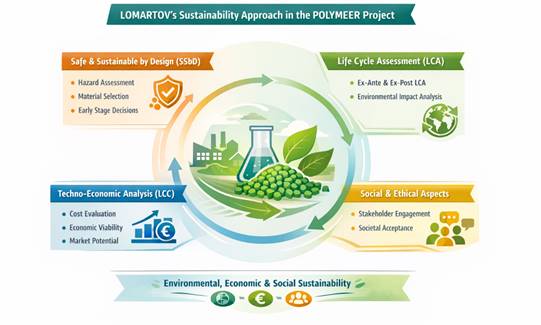
One of LOM’s key contributions to POLYMEER is the implementation of a Safe and Sustainable by Design (SSbD) approach, based on the European Commission’s framework developed by the Joint Research Centre[1].
Why does this matter? Because decisions taken at the earliest stages of development determine up to 80% of a product’s environmental footprint. Once materials reach the market, opportunities for meaningful improvements are limited.
By embedding sustainability from the outset, POLYMEER ensures that its bio-based polymers are not only innovative but also aligned with the EU Green Deal and the Zero Pollution Ambition.
LOM evaluates five decisive aspects when comparing alternative chemicals and processes:
- Hazardousness
- Environmental impacts
- Criticality of raw materials
- Cost-effectiveness
- Technical performance
Balancing these factors allows the consortium to identify the best trade-offs and steer development towards solutions that are safe, efficient and competitive.
Measuring environmental performance across the full life cycle
To demonstrate the environmental benefits of POLYMEER’s bio-based polymers, LOM conducts comprehensive Life Cycle Assessments (LCA). The analysis covers the entire value chain, from brewer’s spent grain (BSG) collection and processing, through polymer production and use, to end-of-life scenarios. Using primary data provided by project partners, the assessments aim to deliver robust and realistic insights into environmental performance.
Two complementary LCA approaches are applied:
- Ex-ante streamlined LCA, used early in development to forecast potential impacts and guide decision-making (integrated within the SSbD assessment).
- Ex-post LCA, a detailed and comprehensive study calculating the environmental impacts of the final developed materials.
This dual approach allows POLYMEER not only to optimise processes during development, but also to quantify and demonstrate improvements compared with conventional fossil-based plastics.
Assessing economic feasibility through techno-economic analysis
Environmental performance alone is not enough for market success. New materials must also be economically viable. In parallel with the LCA, LOM conducts a Life Cycle Costing (LCC) and techno-economic assessment of the bio-based polymer production process. Mirroring the life cycle perspective used for environmental impacts, LCC evaluates:
- Investment costs
- Operating costs
- Revenue projections
- Financial performance indicators
This analysis provides a clear picture of the economic feasibility of scaling up POLYMEER’s technologies and identifies opportunities to improve profitability. By integrating environmental and economic perspectives, LOM ensures that sustainability goes hand in hand with competitiveness.
Building social acceptance through responsible innovation
Beyond technical and economic assessments, LOM promotes Responsible Research and Innovation (RRI) practices across the consortium. For bio-based polymers to succeed, they must be accepted by industry, end-users and society at large. LOM supports the project by analysing stakeholder expectations, concerns and needs, helping to align technological development with the public interest and ethical considerations.
By engaging partners and stakeholders, POLYMEER strengthens support for its solutions and increases the likelihood of successful market uptake.
Addressing the challenges and opportunities of bioplastics in Europe
Bioplastics are widely recognised as a key pillar of Europe’s transition towards a circular bioeconomy. However, their successful development and market uptake depend on more than environmental performance alone.
Challenges include ensuring sustainable feedstock sourcing, meeting technical performance requirements, achieving cost competitiveness and designing effective end-of-life solutions. At the same time, social acceptance is crucial. Public trust, transparency regarding safety and environmental benefits, and alignment with societal expectations strongly influence whether new materials are embraced by the market.
Through this integrated approach, LOM helps POLYMEER deliver bio-based polymers that are environmentally sound, economically viable and socially accepted, supporting Europe’s green transition in a meaningful and responsible way.
[1] . Caldeira et al., ‘Safe and sustainable by design chemicals and materials – Framework for the definition of criteria and evaluation procedure for chemicals and materials’, JRC Publications Repository. [Online]. Available: https://publications.jrc.ec.europa.eu/repository/handle/JRC128591