Based in Ghent, Belgium, Normec OWS is the global market leader in biodegradability and compostability testing of a wide range of materials. As a one-stop laboratory for degradation and toxicity testing, the company combines more than 35 years of expertise with strict quality standards and internationally recognised methodologies. In addition to its advanced laboratory services, Normec OWS provides consulting in areas such as waste management, recycling, legislation, auditing, and life cycle and sustainability assessments, supporting both public and private sector clients.
By integrating scientific testing with regulatory insight and practical application knowledge, Normec OWS helps bridge the gap between innovative material development and validated environmental performance. The organisation is actively involved in certification and standardisation committees, as well as European projects and international initiatives, contributing to the advancement of global sustainability standards.
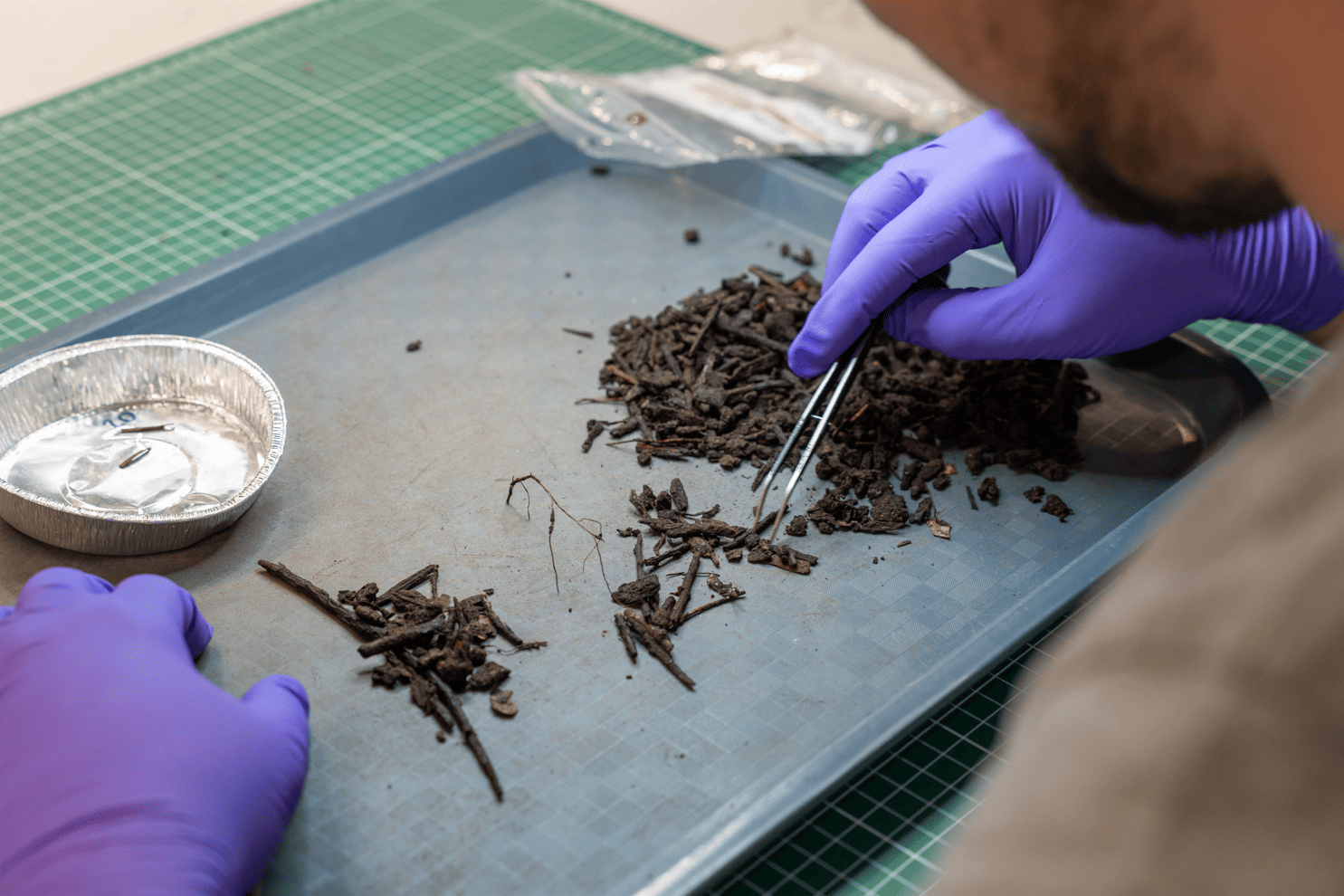
Within POLYMEER, Normec OWS leads Subtask 2.5.1 on biodegradability, evaluating newly developed polymers in accordance with international standards across different environments. This work determines their biological end-of-life pathways, such as composting and anaerobic digestion, while also assessing the risks related to environmental leakage and microplastic formation. Particular attention is given to agricultural and packaging applications, with dedicated testing on mulch films to assess biodegradation in soil and their disintegration behaviour under realistic conditions.
The Basics of Biodegradation
Biodegradation is a natural process in which microorganisms such as bacteria and fungi break down materials into simpler substances like water, carbon dioxide (CO2) and biomass. In absence of oxygen, anaerobic biodegradation occurs and methane (CH4) is produced instead of CO2.
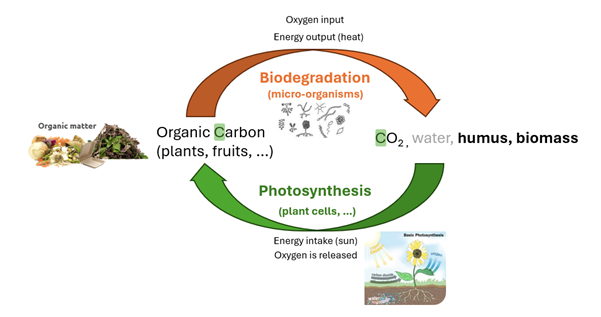
Biodegradation can occur in controlled environments (such as industrial composting or anaerobic digestion) as well as in open environments (such as soil, freshwater or marine environment). In controlled environments, biodegradation occurs under optimized conditions that enable efficient and predictable breakdown, whereas biodegradation in open environments is slower, less consistent, and strongly influenced by natural factors like temperature, moisture, and microbial activity. Therefore, the term “biodegradable” should always be defined in relation to a specific environment.
In the figure below, the different environments are ranked from generally more aggressive (compost) to least aggressive (landfill). The provided temperatures are the ones used in the standardized test methods. These temperatures do not necessarily reflect real-life temperatures, as lab testing is often accelerated by increasing the temperature.
Biodegradation vs. Disintegration
It is important to distinguish between two often-confused concepts:
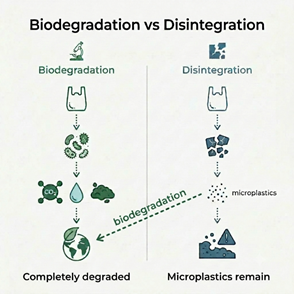
- Biodegradation refers to the complete chemical breakdown of a material by microorganisms into CO2, water and biomass.
- Disintegration refers only to the physical breakup of a material into smaller pieces.
A material can disintegrate without truly biodegrading, for example, by fragmenting into microplastics. For a material to be considered fully biodegradable, it must be converted into CO2, biomass and water within a reasonable time frame, not just broken down into smaller fragments.
Why It Matters
Understanding biodegradation is essential for evaluating the environmental impact of materials. Not all “biodegradable” products behave the same way. Performance depends strongly on the conditions they are exposed to. To accurately assess environmental performance, it is important to distinguish between the conditions a material is designed for and the conditions it will actually encounter in practice. Materials only deliver their intended sustainability benefits when these two aspects are properly aligned.
Challenges and opportunities of bioplastics in the EU and EU projects
Bioplastics, including biodegradable and compostable materials, are increasingly discussed as part of Europe’s transition to a circular economy. However, their role remains complex, shaped by evolving legislation, market dynamics, and infrastructure readiness.
Key Challenges
One of the main challenges lies in regulatory uncertainty and policy direction. In recent years, EU policies aimed at reducing plastic waste, such as single-use plastics restrictions, have often led to a shift away from plastics altogether toward paper-based alternatives. While this reduces reliance on conventional plastics, it can unintentionally limit the uptake of biodegradable or compostable plastics, as these materials are not always clearly recognized in legislation.
As a result, biodegradable and compostable products currently occupy a limited space in the market. Moreover, their use is often restricted to specific applications, as concerns persist regarding the availability of appropriate collection and treatment infrastructure, as well as the risk of contamination of existing recycling and bio-waste streams.
Another challenge is the fragmentation of standards and end-of-life systems across EU Member States. Compostable plastics require specific conditions (e.g. industrial composting) that are not uniformly available, making it difficult to scale solutions across Europe.
Emerging Opportunities
Despite these challenges, there are important opportunities emerging at EU level, particularly through the proposed Packaging and Packaging Waste Regulation (PPWR).
The PPWR introduces a more nuanced approach, recognizing that compostable plastics can provide clear environmental benefits in specific applications. In the near future, the use of compostable materials will be mandatory for certain packaging uses, such as:
- Tea bags
- Coffee pods
- Fruit and vegetable stickers
- Very lightweight plastic carrier bags
These are applications where contamination with organic waste is likely and where compostable materials can improve waste collection and treatment outcomes. Member states can decide to expand this list with other relevant products, such as sauce sachets, food-soiled packaging, cling film and bakery wraps. This regulatory shift signals a more targeted and functional role for bioplastics, rather than positioning them as a universal replacement for conventional plastics.
Furthermore, agricultural applications (particularly biodegradable mulch films) represent a key opportunity within the EU policy framework, largely due to the EN 17033 standard and their inclusion in relevant legislation. EN 17033 provides a harmonised set of requirements and test methods for soil-biodegradable mulch films, ensuring verified biodegradation, environmental safety, and performance, while serving as a common reference across Member States. In parallel, recent updates to the EU Fertilising Products Regulation (EU) 2019/1009 explicitly recognise soil-biodegradable mulch films as soil improvers, allowing CE marking and facilitating EU-wide market access. Together, these developments reduce regulatory fragmentation, increase market trust, and create favourable conditions for scaling biodegradable solutions in agricultural applications where conventional plastics are difficult to recover or recycle.
Outlook
Overall, the future of bioplastics in the EU is moving toward a more selective and evidence-based approach. While broad substitution of plastics remains unlikely, targeted applications, supported by clear legislation and standards, offer strong potential for biodegradable and compostable materials to contribute to Europe’s circular economy.