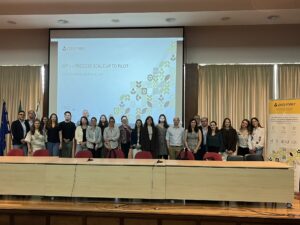
Sapienza University of Rome (UNIROMA1), founded in 1303, is one of the world’s oldest and largest universities. Its main campus in Rome, along with sites in Latina and Rieti, hosts a vibrant academic community of 125,332 students, including nearly 12,000 international students.
Sapienza offers a comprehensive range of programs, with 311 Bachelor’s and Master’s degrees, 98 PhD programs, and 73 courses taught in English. The university is supported by a substantial academic workforce of 3,574 faculty members and more than 2,500 technical and administrative staff, along with over 1,000 personnel in its university hospitals. Sapienza is a major research institution, securing significant international and national funding, including 23 ERC Grants, 64 Marie Skłodowska-Curie Actions, and more than €27 million in Horizon Europe funding. Its innovation ecosystem includes 56 spin-offs and start-ups and a portfolio of 466 patents. Overall, Sapienza stands out as a leading research university with a strong international orientation, a large and diverse student body, and a long tradition of academic excellence.
UNIROMA1 leads WP2, which focuses on the development of high-performance, sustainable bio-based polymers for textile, tertiary packaging and agricultural applications, combining functionality with environmental responsibility. The work will define critical requirements for processability, in-service performance, and end-of-life management, guiding the design of innovative polymer formulations with tunable biodegradation and recyclability. By optimising processing conditions and correlating them with thermal, mechanical, and functional properties, WP2 will produce lab-scale compounds ready for industrial scale-up. Through the integration of materials innovation, process engineering, and circular economy principles, UNIROMA1 will drive this WP2 to deliver solutions that are technologically advanced, environmentally sustainable, and directly translatable to real-world applications.
The UNIROMA1 team, composed of Fabrizio Sarasini (Full Professor, Department of Chemical Engineering, Materials, Environment), Jacopo Tirillò (Full Professor, Department of Chemical Engineering, Materials, Environment), Maria Paola Bracciale (Tenure-Track Researcher, Department of Chemical Engineering, Materials, Environment), together with postdoctoral researchers, specializes in the formulation of sustainable polymer blends for industrial and structural applications. Their work integrates bio-based matrices, natural fibers, and recycled or agro-industrial waste to develop high-performance, eco-friendly composites with tunable properties, including durability and end-of-life biodegradability or recyclability. By combining materials chemistry, polymer processing, and thermo-mechanical testing, the group delivers solutions that merge technological performance with environmental responsibility. In addition, UNIROMA1 actively supports other WPs by contributing to scaling-up, participating in sustainability assessments, and engaging in dissemination and exploitation activities.
Laboratory-scale formulation development and associated challenges
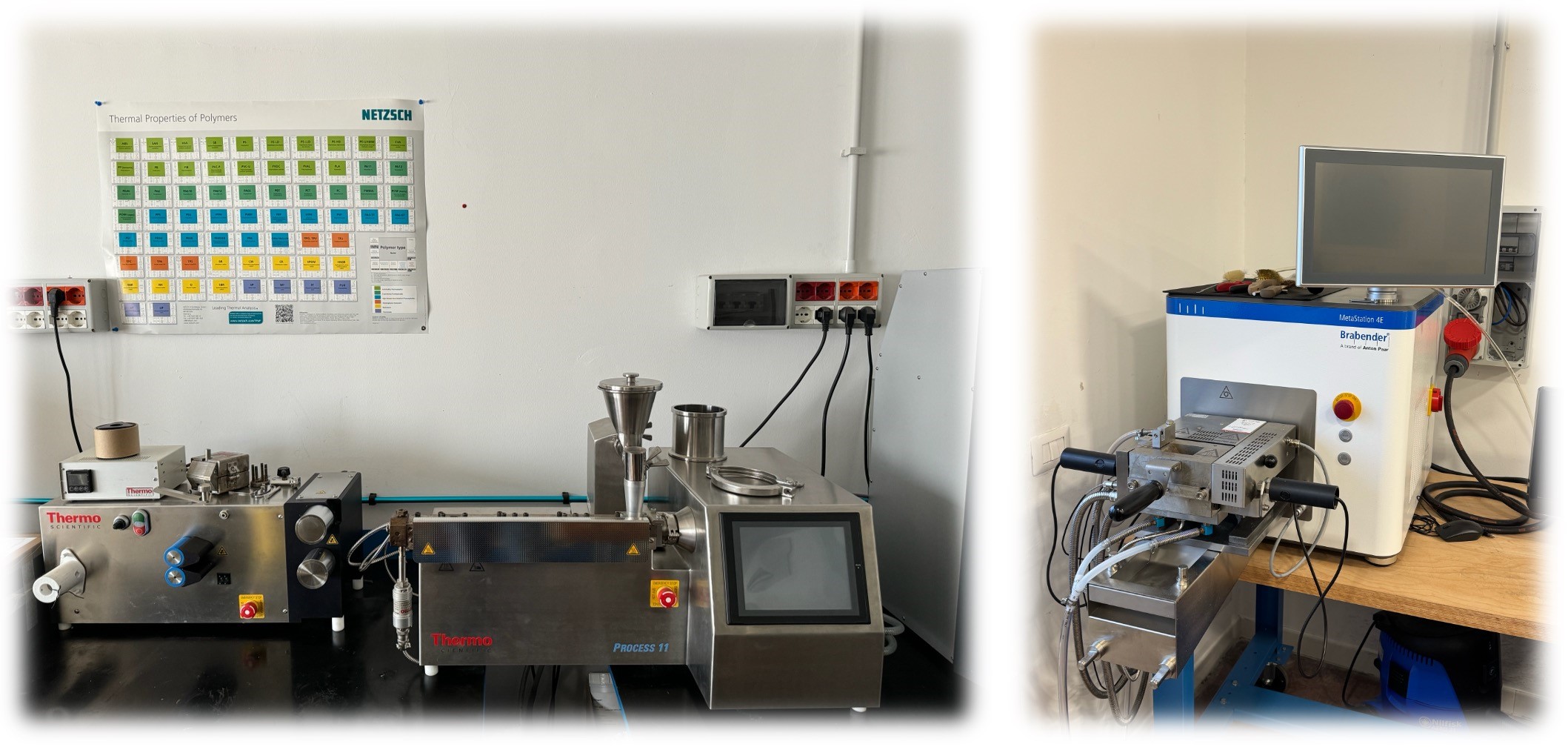
UNIROMA1 will produce laboratory-scale formulations using both batch and continuous melt compounding on a twin-screw extruder, working with the innovative biobased developed in the project. Key challenges include optimising screw speed, torque, temperature profiles, and dwell time to accommodate the unique rheological behaviour of these polymers while avoiding degradation or poor mixing. Rheological tests, density measurements, and melt flow index assessments will guide this optimisation, although interpreting data for novel polymers can be complex due to non-Newtonian flow behavior and thermal sensitivity.
An iterative refinement approach will address compatibility between plasticizers, additives, and the innovative polymers, adjusting formulations to achieve the desired mechanical, thermal, and processing properties for the different envisaged applications. Incompatible combinations may lead to phase separation, inhomogeneity, or reduced performance, making careful evaluation of each blend critical.
Optimised formulations will be injection-molded into test specimens for quasi-static mechanical and viscoelastic property assessment. Challenges include scaling from laboratory compounding to injection molding while controlling microstructure and crystallinity to reliably correlate processing conditions, formulation, and final performance.
Overall, careful balancing of formulation design, processing parameters, and characterisation is essential, with iterative testing required to mitigate the risks of incompatibility, processing instability, and property variability.
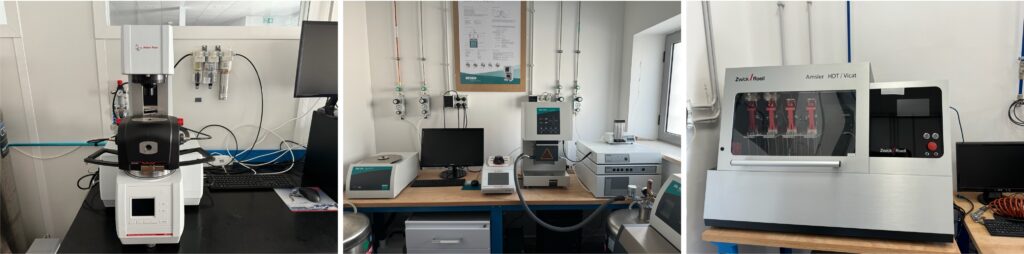
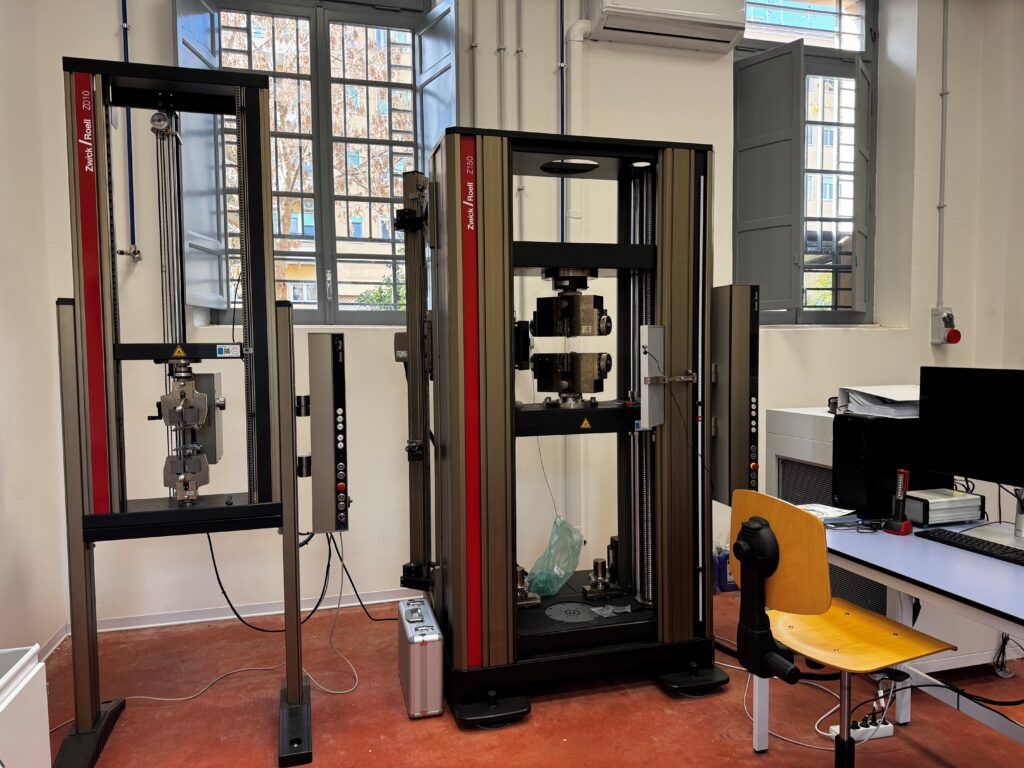
The laboratory is equipped with an extensive range of state-of-the-art instrumentation for advanced materials testing and polymer processing. Mechanical characterisation is supported by high-precision universal testing machines for monotonic loading (tensile, compression, flexural) and servo-hydraulic and/or electrodynamic systems for fully controlled cyclic and fatigue testing, with capabilities for multi-acis loading, high acquisition rates, and environmenal conditioning.
Thermal analysis instrumentation includes DSC, TGA-FTIR, dialometers for dimensional change and CTE determination, DMA for frequency- and temperature-dependent viscoelastic behaviour, and HDT/Vicat systems for thermomechanical softening and heat resistance testing under defined loads. For barrier property evaluation, the laboratory features dedicated permeability analyzers for the determination of oxygen, water vapor, and CO2 gas transmission rates in polymer films. Rheological characterisation is performed using an advanced rotational rheometer and extrusion plastometer. The processing area includes co-rotating twin-screw extruder designed for reactive extrusion, compounding, dispersion, with modular screw confirguations and precise thermal management. A high-torque closed internal mixer is available for bacth melt-mixing, enabling controlled formulation development and small-scale compounding under defined shear and temperature histories.
Challenges and opportunities of bioplastics in the EU
The development and deployment of bioplastics in the European Union are influenced by a complex set of technical, environmental, and regulatory factors. Major challenges include the limited and variable availability of sustainable bio-based feedstocks, which may otherwise compete with agricultural land use or be subject to fluctuations in composition and yield. Biodegradable polymers also exhibit heterogeneous degradation profiles, with many requiring tightly controlled industrial composting conditions that are not representative of natural environments. This disparity complicates life-cycle assessments and may lead to misinterpretation of environmental advantages. Moreover, the EU still lacks fully harmonized standards for certification, labeling, and waste management of bioplastics, creating inefficiencies in recycling and composting systems and contributing to waste-stream contamination.
Despite these obstacles, bioplastics offer substantial opportunities aligned with EU strategies for climate neutrality and a circular bioeconomy. Bio-based polymers have the potential to reduce dependence on fossil carbon, and ongoing advances in catalytic, microbial, and enzymatic conversion processes continue to enhance material performance and expand the available portfolio of bio-based monomers and polymers. Progress in mechanical, chemical, and organic recycling technologies further supports the integration of these materials into circular resource loops.
A particularly compelling opportunity lies in the use of waste biomass, such as brewer’s spent grain, agricultural residues, lignocellulosic by-products, and food-processing waste, as feedstock for biopolymer production. Brewer’s spent grain, in particular, is abundant, rich in polysaccharides and proteins, and generated continuously across Europe’s brewing industry. Its valorisation reduces the reliance on primary crops, avoids competition with food production, and transforms a high-volume side stream into a valuable carbon source for bio-polymer precursors. When appropriately pre-treated and fractionated, as exploited in POLYMEER, such waste biomass can yield fermentable sugars, platform chemicals, and bioactive components that serve as building blocks for a range of bio-polymers. Integrating resources into bioplastic production enhances overall sustainability, supports circularity, reduces waste disposal burdens, and strengthens the economic viability of biorefineries within the EU’s emerging circular bioeconomy.