Last week, the European Commission adopted a new strategy to guide Europe’s bioeconomy towards a cleaner, more competitive, and more sustainable future. The 2025 Bioeconomy Strategy is an update of the 2012 bioeconomy strategy and its 2018 revision.
For projects such as POLYMEER, which transform brewers’ spent grain (BSG) — a waste by-product — into recyclable and biodegradable plastics, the new strategy offers both opportunity and validation.
Key highlights of the 2025 Strategy
The bioeconomy already contributes significantly to the EU economy, representing 5% of EU GDP — equivalent to up to €2.7 trillion — and supporting 17.1 million jobs. Each job generated in the bioeconomy supports the creation of three indirect jobs across the wider EU economy.
A wide range of products already stem from the bioeconomy. For example, algae-derived chemicals are used in sectors such as pharmaceuticals and cosmetics. Bio-based plastics are becoming increasingly prevalent in packaging solutions and automotive components, two of POLYMEER’s applications, while demand for bio-based building materials, textile fibres, and fertilisers is also growing. Despite this growth, much of the bioeconomy’s potential remains largely unexploited.
The updated EU Bioeconomy Strategy aims to realise this potential by promoting innovation and investment, developing markets for bio-based technologies and materials, ensuring the sustainability of biomass resources, and strengthening Europe’s position in global bio-based value chains.
The Strategy is structured around four main pillars:
- A circular, resource-efficient bioeconomy that maximises the use of residues, by-products and waste, instead of primary raw materials, and encourages high-value applications over low-value uses.
- Supporting the scaling up of biotech innovations and bio-based manufacturing, including bioplastics, sustainable textiles and chemicals.
- A sustainable and responsible supply of biomass that respects nature, ecosystems, soils and water, promotes circular supply chains, and rewards sustainable providers of biomass such as farmers and foresters.
- It enables European industries to be globally competitive and achieve strategic autonomy, giving them access to global markets, reducing their dependence on fossil imports or non-EU raw materials, and strengthening their resilience in a fragile geopolitical context.
The Strategy also foresees clearer, faster, and more supportive regulatory pathways that combine public and private investment to turn innovations into market-ready, bankable bio-based solutions.
The role of POLYMEER
The 2025 Bioeconomy Strategy strongly aligns with the core objectives of POLYMEER.
- Circular use of secondary biomass: POLYMEER repurposes BSG, a by-product of the brewing industry, to create bioplastics. This is precisely the kind of resource-efficient, circular approach that the Strategy advocates: transforming residues into high-value materials instead of discarding them or using virgin resources. Furthermore, the project’s polymers are circular by design.
- Reducing fossil dependence and increasing European strategic autonomy: By offering alternatives to fossil-based plastics, POLYMEER contributes to the EU goals of decarbonisation, reducing the carbon footprint and increasing competitiveness on a global scale.
- Creating green jobs: As POLYMEER scales up, it can contribute to job creation in the agro-industry, processing, manufacturing, and supply chains, thereby supporting local economies.
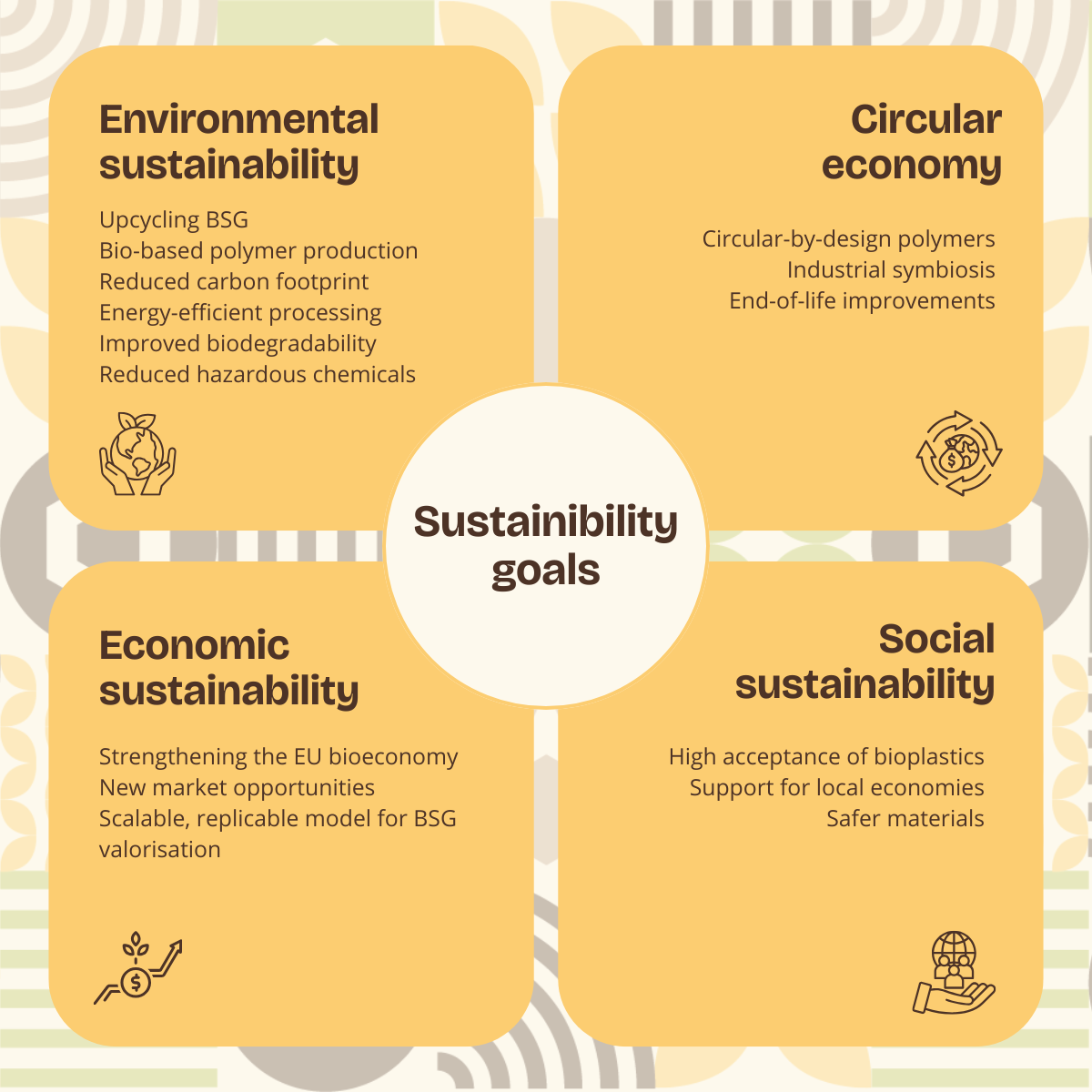
- Environmental sustainability: POLYMEER is deeply committed to environmental sustainability through upcycling BSG, reducing hazardous chemicals, improving biodegradability, and using energy-efficient processing methods.
Challenges
The Strategy acknowledges the following constraints: bioeconomy growth must not come at the cost of biodiversity loss, ecosystem damage, competition with food production, or irresponsible biomass sourcing.
Therefore, in order to deliver the promise of a bio-based Europe, robust governance, transparent biomass supply chains, lifecycle assessments, and regulatory frameworks that truly reward circularity and sustainability are required.
This highlights the importance of considering the entire lifecycle, ensuring the traceability of feedstock (BSG), and communicating environmental benefits to stakeholders, from policymakers to end users, as POLYMEER does.
POLYMEER is a prime example of what can be achieved in this new phase: converting brewery waste into sustainable bioplastics for use in agriculture, packaging, and the automotive industry. The project has the potential to contribute directly to Europe’s green transition, demonstrating that bio-based materials can be both high-performance and environmentally responsible.