The POLYMEER project will establish a sustainable bio-based value chain for bioplastics
Funded by the Circular Bio-Based Europe Joint Undertaking HORIZON programme under Grant Agreement No. 101157411, POLYMEER will run for 48 months from 1 September 2024. The project has received 4.9M€ of funding and involves 14 partners from 8 countries, coordinated by the Università degli Studi di Perugia (UNIPG).
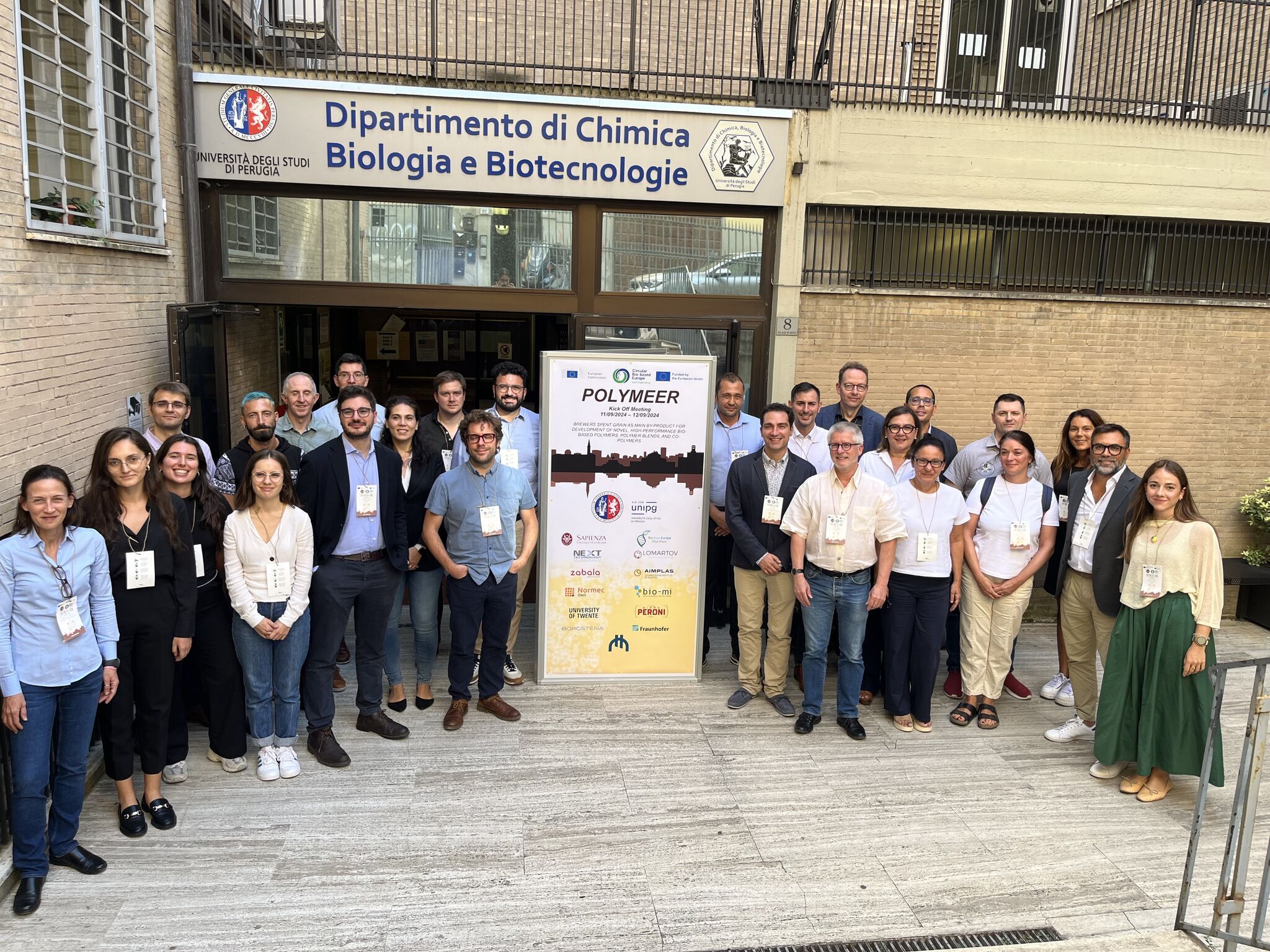
POLYMEER, which aims to establish a sustainable bio-based value chain for bioplastic products, was officially launched in Perugia, Italy, on 11-12 September. By efficiently converting brewers’ spent grain (BSG) into high value-added materials, the project will diversify the range of innovative material solutions capable of replacing traditional plastics.
About the project
Currently, bioplastics account for only 1.5% of global plastics production, with projected growth insufficient to meet market demand. BSG, which is rich in fibre and protein, is mostly used as low-value animal feed or disposed of in landfills, contributing to environmental problems. BSG has potential as a feedstock for bioplastics, but current applications are limited by poor mechanical properties and lack of scalability. POLYMEER aims to address these challenges by developing high-value applications for BSG in bioplastics to replace fossil-based feedstocks.

POLYMEER will develop new bio-based polymers, co-polymers, and polymer blends based on BSG, using green, waste-minimising processes to expand innovative alternatives to traditional plastics. The materials will be chemically designed to meet a specific set of properties for three targeted applications: mulch films for agricultural use, textiles for the automotive industry, and tertiary packaging films for industrial use. All products will be designed to be recyclable and/or biodegradable in specific environments.
Over its 48-month duration, the project will optimise the conversion of BSG into bio-based building blocks to create high-performance bioplastics that compete with conventional materials. It will also assess their life cycle sustainability, cost effectiveness, and scalability, while engaging key stakeholders to ensure market readiness and regulatory compliance.
To achieve POLYMEER’s ambitious goals, UNIPG will work with an international consortium of academic institutions, research centres and companies from 8 countries: Italy (Università degli Studi di Perugia, Sapienza Università di Roma, Next Technology Tecnotessile, Birra Peroni), Belgium (Bio Base Europe Pilot Plant, Zabala Brussels, Normec OWS), Spain (Lomartov, AIMPLAS), Croatia (Bio-mi), the Netherlands (Universiteit Twente), Portugal (Borgstena) Germany (Fraunhofer) and Denmark (Gate2Growth).